The short answer
Dongguan's tooling and precision manufacturing industry turns product ideas into manufacturable goods through 3D modeling, rapid prototyping, mold making and staged production planning — and the discipline to open a mold only when the design is ready.
How far is a product idea from something that can actually be produced?
Many products start as a sketch, a reference photo, or an idea in a designer's head.
But an idea is not a manufacturable product. Reaching production means resolving dimensions, materials, structure, assembly, tolerances, process, cost and quality standards.
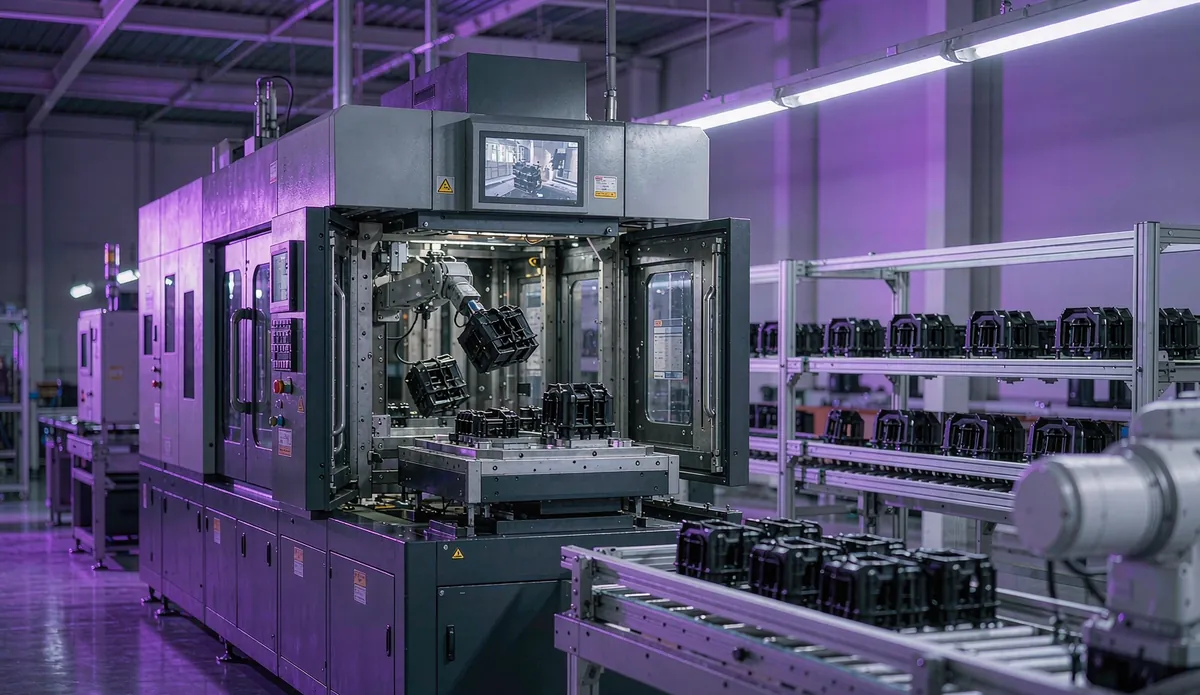
This is where tooling and precision manufacturing matter. Dongguan is a key node in the Pearl River Delta's mold and precision machining supply chain — regional industry research from the Faxiangongchang library highlights Dongguan districts such as Hengli, Chang'an and Tangxia as specialized tooling and precision machining clusters.
Understanding these steps helps an overseas company judge how its own product should be developed — instead of handing a factory a photo and expecting a precise volume price.
Step one is not opening a mold. It is defining the product.
Early in development, several questions need answers:
- What problem does the product solve?
- What are its main functions?
- How does the user operate it?
- What environment and loads must it withstand?
- Which dimensions are critical?
- How many units are planned?
- Is a redesign likely later?
These answers shape design and manufacturing choices. A desktop device enclosure must plan PCB space, ports, vents, screw bosses and visible surfaces. A custom metal bracket must resolve load, thickness, bend positions, holes and mounting. A collectible model prioritizes surface detail, parting, color, material and display stability.
Without these definitions, a supplier may produce something — just not what the client had in mind.
3D models and engineering drawings: turning ideas into production language
3D models and 2D drawings do different jobs. The 3D model helps everyone understand shape, structure and assembly. The 2D drawing pins down dimensions, tolerances, materials and machining requirements.
Common formats:
- STEP: exchanging solid models between CAD systems
- STL: 3D printing
- IGES: some 3D geometry exchanges
- DXF: 2D profiles, laser cutting and some machining
- PDF drawings: dimensions, technical requirements and manufacturing notes
A file format alone does not make a model manufacturable. Missing wall thickness, assembly gaps, draft angles or key tolerances still require engineering review.
Choosing between 3D printing, CNC and injection molding
This is one of the most consequential development decisions.
3D printing: fast verification
3D printing suits concept models, appearance samples and some functional prototypes, without tooling investment.
But technologies differ widely: FDM for early structure checks; SLA where appearance detail matters; SLS and MJF for complex structures and functional samples; metal printing for specific metal structural parts.
Printable does not equal suitable for volume sales.
CNC machining: precision parts and material validation
CNC cuts parts from real material — aluminum components, metal brackets, precision structural parts and some plastics. Accuracy is high and materials are genuine, but per-unit cost rises for complex structures at larger quantities.
Injection molding: stable plastic volume production
Injection requires tooling, but with a stable structure and reasonable scale it is the right choice for scaled production. Upfront considerations include:
- Wall thickness
- Draft angles
- Parting lines
- Gate locations
- Ejector pin positions
- Material shrinkage
- Mold life
- Appearance requirements
Each of these shapes both quality and tooling cost.
Why opening a mold too early is a mistake
A mold fixes part of the design. If the structure is still changing, revising after tooling means modification fees, lead-time slips and revalidation.
Development should separate phases deliberately:
- Concept verification: does the look, size and basic function hold up?
- Engineering verification: structure, assembly, materials, manufacturability.
- Production preparation: freeze the design; confirm tooling, process, inspection standards and packaging.
- Volume production: build to confirmed specifications with quality checks.
Not every project needs the full pipeline — investment should match product maturity. A simple acrylic display stand may skip most of it; an electronic product with moving parts should not.
How to budget product development
Development budget is more than the final unit cost:
- Industrial design fees
- 3D modeling fees
- Engineering drawing fees
- Prototype costs
- Tooling and fixtures
- Sample revisions
- Testing and inspection
- Batch production
- Packaging and shipping
Two ownership questions belong in the contract, not in an afterthought: who owns the design files and IP, and who owns the mold — including where it is stored and who pays for future modifications.
How WOW helps move an idea to a physical product
WOW's product development directions include:
- Product concept organization
- Industrial and structural design scoping
- 3D modeling
- 3D-printed prototypes
- CNC machining
- Silicone (vacuum) casting
- Injection molding and tooling development scoping
- Small-batch manufacturing
- Matching packaging and merchandise
Depending on the project, deliverables may include concept drawings, 3D models, STEP files, STL files, 2D engineering drawings, material notes and production specifications. Design depth, engineering verification, machining capability and testing are confirmed item by item — no project is defaulted into a single service template.
If you have a product idea without complete production files, send WOW the sketch, reference images or functional brief. The first step is defining the development questions; then sampling and manufacturing paths can be assessed.